Red Curtice meant it. He worked
nights, poked through the plant getting to know production and engineering, volunteered to
do some selling. He soon caught the eye of John Lee Pratt, then member of G.M.'s
presidential staff and director since 1923. Says Pratt, now 75, "Some of these
accountant fellows just sit and look at pieces of paper. That young redheaded fellow
started going down in the plant and found out what determined his costs. He had to learn
the technical side of the business, and he went out and learned it." Within a year
after he was hired, at the age of 21, Curtice was made controller of AC Spark Plug.

With time out for a World War I stint
overseas in the field artillery (he came out a private first class), Curtice rapidly rose
to AC assistant general manager, vice president, and at 36, president. Then, in 1933, came
an opportunity born of disaster. General Motors' Buick, for years a notable success as the
safe, sound and respectable "doctor's car," was in dire trouble. It had gone up
in price, fallen behind in styling, grown fat and heavy (one model was inelegantly
nicknamed the "pregnant Buick," the "bedpan Buick" and the
"bathtub Buick"). When Depression struck, it hit Buick square in its middle-age
spread, and Buick's share of the auto market dropped from more then 8% to 2.9%, a mere
43,809 cars. G.M. directors talked darkly of dropping Buick from the company, but
Executive Vice President William Knudsen, the Great Dane, took another view. He aimed to
"get Buick off relief," and thought the man to do it was Red Curtice. Other G.M.
brasshats were skeptical since Curtice had had no auto experience. Said Knudsen:
"Vait and see."
Curtice's first decision was to "make car to sell at lower cost"; his second was
to get Harley Earl, who was driving Cadillac at the time, to design a Buick "you
would like to drive." The result was a new, light and cheap Special. As the new car
was being readied for production Curtice swung around the country getting to know his
harried dealers, talking over their problems and boosting morale. On many a trip, he took
his wife and even his mother, who played poker with Curtice and his associates between
stops.

Back in Flint, Curtice weeded out the
deadwood, kept the good. Under his predecessor, every section of the Buick operation went
its own way, with production problems being blamed on engineering, engineering problems
blamed on styling, and so on down the line. Curtice called in the heads of all departments
on major decisions so that each might know the others'problems and help in their solution.
He also had the ads changed to plug the theme that Buick was an auto for the young, with
such headlines as "DRESSED FOR A PARTY - POWERED FOR A THRILL!"
The Curtice medicine soon took effect. In a year Buick's sales rose 44% to 63,067, in two
years more to 160,687. In the black days of 1938, while the rest of the industry slumped
47%, Buick's sales slipped but 19%, and Buick went from sixth to fourth in the business.
By 1941 it had sales of 308,616, or 8.4% of the auto market.
Under Curtice in World War II, Buick turned out 75,000 Pratt & Whitney engines, 2,507
M-18 tank destroyers and an arsenal of artillery shells. By the time Charlie Wilson picked
him as his right-hand man in 1948, Curtice's interests ranged over all of G.M. But in his
new job as executive vice president, Curtice could apply one of his greatest talents as
overall styling boss of the corporation.

Designing a new car involves an
arm-long set of finely balanced equations, and enough unknowns to baffle even the most
imaginative fortune teller. In its syling section, adjacent to the head office in Detroit,
G.M. has a staff of 675 trying to find the answers. Some of them work in the
"future" studio, a place where stylists can doodle their fondest dreams on
paper, even though there is no chance of their coming true. With the practical dreamers,
engineers work side by side to make sure their ideas can be translated into production. To
spot any engineering problems, the quarter-size clay models are fitted with movable
plastic engines, gearboxes, seats, etc.
To find out what the public wants, G.M.'s customer research department questions 2,000,000
people a year by mail on their likes and dislikes. G.M.'s traveling Motorama provides
another fine source of information with interviewers stationed by every experimental car.
The results are all carefully tabulated, passed along to styling and engineering and to
President Curtice, who studies them carefully. The surveys are important, e.g., pushbutton
doors were made standard equipment when the research department found that 70% of the
people interviewed preferred them to handle doors. But surveys would be worthless without
a sure styling instinct. Last year Harlow Curtice looked over the roomful of experimental
cars' picked the experimental Pontiac and Chevy station wagon as the cars the public would
like best. His stylists disagreed, but Curtice's judgment was borne out by the research
department poll.
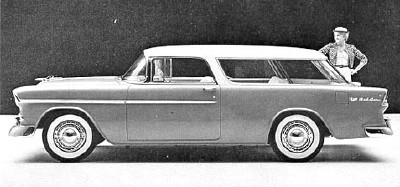 |
| 1955
Chevrolet Nomad Wagon |

Such careful planning and coordination
between styling, engineering, production and sales have helped make General Motors the
world's biggest manufacturing company, with 583,000 employees in 152 plants, and almost as
many stockholders. One of its bulwarks is its depth of executive talent. Groaned a
competitor: "Like Notre Dame, they've got ten men for every position." While
Harlow Curtice has not named anyone to take his old job as the president's right-hand man
- and thus be his heir apparent - there are many who might ultimately step into the
president's shoes.
Size, however, has its problems as well as its rewards. From a political standpoint, G.M.
offers a tempting target. In the last two years under Curtice, while G.M.'s share of the
auto market has risen from 41.7% to 49.9% (and Ford's has gone from 22.8 % to 30.8 %).
Chrysler's share has plummeted from 21.3% to 13.5%. The former independents, which in 1952
accounted for 13.2 % of auto sales, have dropped this year to 5.8%. Studebaker and
Packard, Kaiser and Willys, and Nash and Hudson have had to team up to stay in business.
The Eisenhower Administration, which does not view bigness in itself as cause for
antitrust action, is nevertheless considering eight possible auto suits involving such
things as dealer contracts, finance-company tie-ins and sales of parts. And under an
Administration less friendly to business, any new boost of G.M.'s share of the market
might well bring an all-out antitrust attack.
If it wanted to, G.M. could probably drive Chrysler and the former independents to the
wall by cutting prices low enough. Harlow Curtice has no intention of doing so - and for
the sake of national security, no Administration would sit idly by and watch if he tried.
Thus 1955 will be a year of decision for General Motors as well as the rest of the auto
industry. Harlow Curtice does not plan to help his competitors compete. As he says:
"I don't see how we can stop people from buying G.M. cars." But he fervently
hopes that they will be able to stand up to his Goliath and fight - and thus keep the long
arm of the Government from mixing in the auto industry. Curtice thinks his competitors can
do it, and so do they. For automen 1955 may well provide the answer.



